 |
 VII: Biological Oxidations 1939 |
 |
|
|
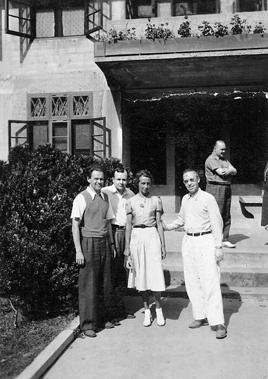
Dr. Fritz Lipmann, The Burkes, The Salomans  SYMPOSIUM SYNOPSIS LIST OF PARTICIPANTS CONTENTS OF SYMPOSIUM VOLUME PHOTOGRAPHS PUBLISHED VOLUME  |
Biological Oxidations
20 June - 21 July, 1939
Symposium Synopsis
Organizer: Eric Ponder
The period from the latter part of the 19th century through the 1940s may be regarded as a golden age of biochemistry, a time when the laboratories and lecture halls were ruled by giants such as Hoppe-Seyler, Buchner, Paster, Fischer, Hopkins, Warburg, Keilin and so on. During this period, the fundamental metabolic pathways of the cell were being elucidated by scientists whose names have become eponymous with their discoveries; for example, Gustav Embden, Otto Meyerhof and Hans Krebs. It is not surprising, then, that Ponder commented on the topic of the 1939 Symposium that “A more timely subject could scarcely have been chosen, for it is one which has come to of the first importance in the investigation of cellular chemistry, whether physiological or abnormal”.
A key experimental strategy was to use organic dyes for which oxidation-reduction potentials could be determined accurately, and then to use these dyes as indicators in biochemical reactions. The first seven papers were devoted to this approach, including those by W. Mansfield Clark, who opened the Symposium, and L Michaelis who followed him. There were, as had already become a tradition, future Nobel laureates among the participants. Carl Cori who was to share the 1947 Prize in Physiology or Medicine with his wife, Gerty, and Bernardo Alberto Houssay, spoke on their studies of glycogen breakdown. Fritz Lipmann also worked on glycolysis and demonstrated the requirement for a co-factor, co-enzyme A. For this discovery, he shared the Nobel Prize in Physiology or Medicine 1953 with Hans Krebs. Lipmann continued to attend Cold Spring Harbor Symposia, and he celebrated his 80th birthday at the 1979 Symposium.
Search images:
